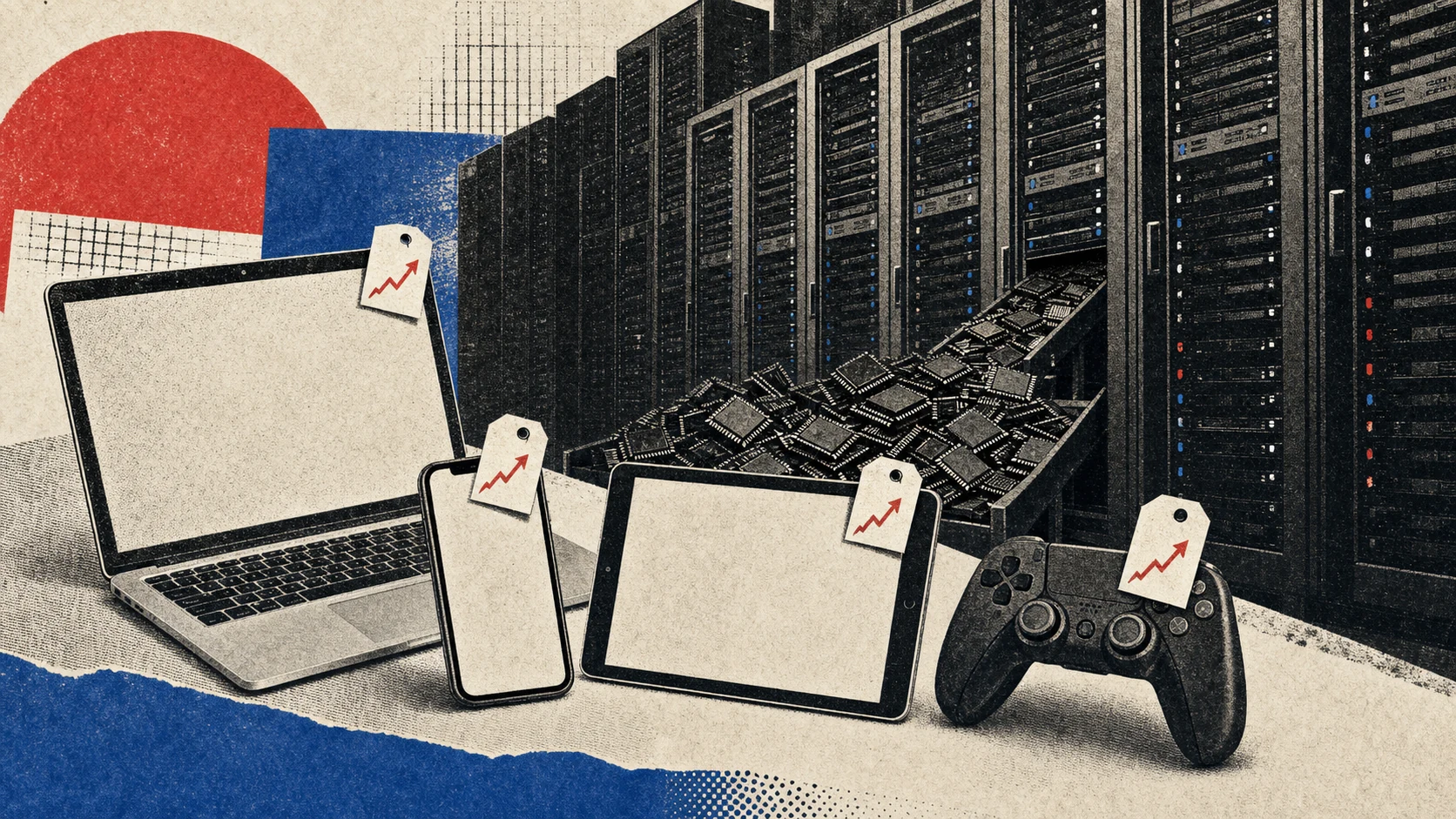
For years, a familiar bargain governed personal technology. A new laptop might gain speed while keeping the old price. Storage grew cheaper. Last year's premium feature became this year's standard one. The buildout of artificial intelligence is beginning to disturb that pattern, and June supplied evidence that some effects may be reaching consumer-device prices.2,3
Micron, one of the major producers of memory and storage, reported $41.46 billion in quarterly revenue on June 24, up from $23.86 billion in the previous quarter. Its chief executive described memory as strategically valuable in the AI era, while the company forecast another sharp rise in revenue. Two days later, reporting on Apple and Microsoft price increases connected the component squeeze to devices people actually buy.1,2
This does not mean an AI surcharge will appear as a line on every receipt. It means cloud companies have become enormous competing buyers for parts that also sit inside phones, PCs and consoles. When supply cannot expand quickly enough, consumer products lose the quiet cost decline that buyers have learned to expect.1,2,3
Memory became infrastructure
Modern AI systems use vast quantities of specialized memory close to their processors. The most sought-after products are not identical to the memory inside a budget laptop. AI demand can nevertheless intensify competition for engineering attention, factory capacity, packaging and capital across the memory supply chain. How much of that pressure reaches a particular consumer device varies by component and manufacturer.1,3
Micron's June results show the scale of the data-center market. It reported $13.77 billion in revenue from its Cloud Memory Business Unit, $11.52 billion from its Core Data Center Business Unit and $11.52 billion from its Mobile and Client Business Unit. Those categories also reported unusually high margins, but the release alone does not prove the cause of every consumer price change.1
The relevant household lesson is not that a server part can be placed directly into a phone. The same industrial system allocates capital and production across several memory markets. New fabrication plants and advanced packaging capacity take time to build, while demand can change much faster.1,3
June moved the pressure onto price tags
Axios reported that Apple raised prices by as much as 25 percent on selected MacBook and iPad models and cited soaring memory costs linked to AI demand. Microsoft announced Xbox increases of as much as $150. The companies have different products, markets and pricing strategies, so the increases should not be treated as one universal component index. The report suggests that some brands are passing through at least part of their higher costs.2
Microsoft said storage and memory costs had more than doubled since the previous autumn, according to the report. Consoles are especially exposed because manufacturers often accept thin hardware margins in the hope of earning money from games and services later. When a central component jumps, there is little room inside the device price to hide it.2
CNBC reported that higher memory costs may push up consumer-electronics prices and contribute to shortages. The available report does not establish how individual retailers will respond, so shoppers should watch actual model availability and checkout prices rather than assume empty shelves are inevitable.3
The cheapest model may change before the sticker does
Device makers have several ways to respond before announcing a headline price increase. They can reduce included memory, charge more for storage upgrades, remove a high-capacity model or steer buyers toward subscriptions and financing. They can also hold the price and accept a lower margin for one cycle. This is why shopping by model name alone can miss the real change.2,3
A $699 laptop with 8 GB of memory is not the same value as last year's $699 laptop with 16 GB, even if both sit under the same family name. A phone that keeps its launch price but loses a generous trade-in offer has also become more expensive. The useful comparison is total configuration and final checkout cost, not the advertised starting number.2
The squeeze may also change lower-priced configurations. In some models, smaller memory tiers may be less able to run future local-AI features even while receiving ordinary operating-system updates. That is a possibility to check against the exact product specification, not a consequence established for every device by the June reports.
Waiting is useful only when the current device still works
A shortage is not a reason to panic-buy. Forecasts change, manufacturers renegotiate supply, and promotions can appear even in a rising market. A rushed purchase may lock in the wrong operating system, screen or repair profile for years. The better first question is whether the current device is failing at a task that matters.
If replacement is already necessary, define a minimum memory and storage floor before looking at sale banners. For a general-purpose computer expected to last several years, paying for adequate RAM now can be cheaper than replacing a sealed machine early. Storage can sometimes be added externally; soldered memory usually cannot.3
Price histories and retailer alerts are more useful than launch-day excitement. Compare the exact model number across several sellers, include warranty and charger costs, and check whether an apparently large discount is measured against a price that few people paid. Refurbished business laptops remain a practical alternative when repairability matters more than new AI features.
Phones, tablets and consoles need different decisions
Phone buyers should look beyond storage capacity. Software support length, battery replacement policy and trade-in value can outweigh a small launch discount. If a manufacturer keeps the price steady by using less memory, future on-device AI tools may be the first features to expose the compromise.2,3
A tablet used for reading, video and notes does not need the same memory as a machine used for large creative projects. The pressure to buy a higher tier often comes from fear of future features. Buy for a realistic three-to-five-year workload, then verify that the chosen model has enough free storage after the operating system and offline media.
Console buyers face a simpler but more time-sensitive comparison. A known price rise with a published effective date can make an earlier purchase rational if the exact console was already planned. It still makes little sense to buy hardware for a vague future game, especially when subscription costs, storage expansion and controllers can exceed the initial difference.2
AI services may carry the same pressure in another form
Hardware is only one route through which infrastructure costs reach consumers. Companies can set daily generation limits, reserve larger models for paid plans or move useful features behind cloud storage bundles. The device may stay affordable while the ongoing service attached to it becomes harder to avoid.1,2
That changes the purchase calculation. A laptop marketed around an assistant may require an account and continuing subscription for its most attractive functions. Buyers should ask which features run locally, which require the cloud, what happens after a trial ends and whether ordinary device functions still work without the AI plan.
The same questions apply to phones and smart-home devices. A hardware discount is not generous if the product becomes dependent on a service whose price can change. Local operation, data export and a useful manual mode are forms of price protection as much as privacy protection.
A household response that does not require prediction
Nobody outside the supply chain can name the exact month when memory prices will ease. Micron's results describe exceptional demand and investment, while independent reports document prices already moving. Both can be true alongside future corrections. A sensible household plan does not need a perfect market forecast.1,2,3
Extend the life of devices that remain secure and repairable. Back up data before a failure turns replacement into an emergency. Keep a short list of acceptable configurations and watch their real selling prices. When buying, favor enough memory, a long update commitment and replaceable parts over an AI label whose service terms remain unsettled.
Schools, libraries and small businesses face the same pressure on a larger scale. They can avoid emergency replacements by keeping an inventory of device age, battery condition, free storage and support dates. Buying one standardized model in a planned cycle can simplify repairs. In a volatile market, staged purchasing is a risk-management option rather than a universal rule. Leasing deserves the same full-cost comparison as buying, including return conditions, damage charges and whether memory is sufficient for the whole term.2,3
Used-device markets may also tighten if new models rise in price. A refurbished machine remains attractive only when its battery, update horizon and warranty are documented. Check activation locks and enterprise management before payment, and confirm that the seller allows a return after setup. A low sticker price cannot compensate for a device that is tied to another account or stops receiving security updates within months.
The AI boom has often been discussed as a distant argument about jobs and data centers. June made the household connection more concrete. The first unavoidable cost for many people may be neither a subscription nor a lost role. It may be the moment the ordinary laptop they were going to buy stops getting cheaper.2,3
- Compare exact memory and storage configurations, not family names.
- Track final checkout prices across several weeks when a purchase is not urgent.
- Check which advertised AI features require a continuing cloud subscription.
- Prefer long software support and repair options over a marginal performance upgrade.
Sources and method
We treated Micron's figures and outlook as company statements, not neutral forecasts. Consumer price examples come from independent reporting published on June 26. The article does not assume every device will rise by the same amount, and it separates observed June price changes from possible future shortages.
- Micron Technology reports record fiscal third-quarter results Micron Technology · June 24, 2026 · primary
- The AI price shock is here: Apple, Microsoft hike prices Axios via Yahoo Finance · June 26, 2026 · independent
- Rise in memory chip costs puts pressure on retailers of laptops and smartphones CNBC via RetailWit · June 26, 2026 · independent