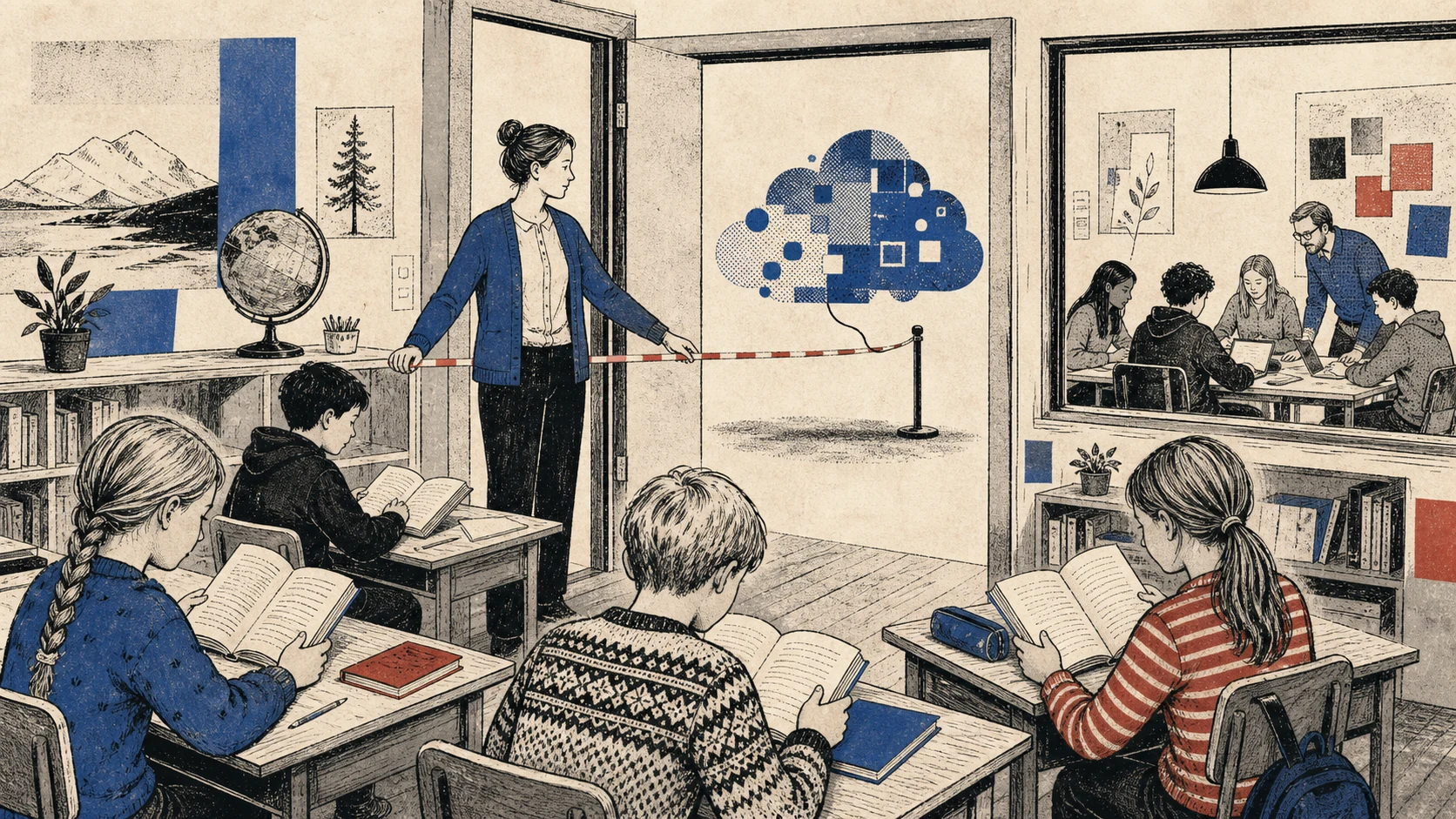
Norway drew an unusually clear classroom line on June 19. Pupils in years one through seven, roughly ages six to thirteen, should generally not use generative AI at school. Older pupils will receive age-appropriate, teacher-led access rather than an unrestricted chatbot account.1,2,3
The government linked the policy to reading, writing and mathematics. It argued that children can skip the mental steps that build those abilities when a generative tool supplies finished language or answers too early. The June announcement therefore focuses on protecting practice in foundational subjects.1,2
This is neither a national rejection of AI nor a claim that children should never learn how it works. It is an age sequence: establish basic skills first, then introduce the tool with supervision and explicit teaching. Families elsewhere can use the same sequence even where no national rule exists.1,2,3
The policy protects the work inside the answer
A finished paragraph hides the reading, recall, sentence planning and revision that produced it. When a child asks a model to complete those steps, the submitted page can look stronger while the underlying skill remains weak. A teacher may see polished output without seeing where understanding stopped.1,2
The Norwegian position focuses on that developmental cost. Young pupils need repeated practice forming letters, decoding text, calculating and explaining. Generative AI can demonstrate a result, but demonstration is not the same as a child retrieving and applying knowledge independently.1
The concern is strongest when the tool becomes an invisible default. A classroom may still use software for accessibility, presentation or teacher preparation. The boundary concerns children delegating core learning tasks to a system that produces fluent output without showing reliable reasoning.1,2
Older students receive a different responsibility
Norway's approach changes with age. Teenagers need to understand AI because universities and workplaces already use it. Supervised use can include checking sources, comparing an answer with original material, documenting prompts and identifying where a model invents a fact.1,2
A useful lesson asks the student to critique an AI response rather than submit it. The student can mark unsupported claims, trace a quotation to its source and rewrite weak reasoning. The tool becomes material for study, while the student remains responsible for the final argument.
The age boundary also reduces pressure on primary teachers to monitor an opaque service while teaching basic subjects. Older classrooms can introduce narrower accounts, clearer policies and assignments designed around the technology rather than letting it appear through a browser tab during every task.1,3
Different tools can serve different learning tasks
The policy does not require removing every screen. It distinguishes a generative system that can produce the pupil's answer from tools used for accessibility, presentation, teacher preparation or other defined classroom purposes.1
A printed book or fixed worksheet has limited functions, which can be an advantage during focused practice. It does not generate a finished answer. This is an editorial observation about task design, not a claim that one medium is always superior.
Digital material remains useful for accessibility, current information and adaptive practice. The practical question is whether each medium is assigned to a task it supports, while the pupil still performs the reading, writing or calculation being taught.1
A home rule can be simpler than an AI detector
Parents do not need surveillance software to copy the useful part of Norway's approach. For core homework, ask the child to work from the assigned material first and show notes or intermediate steps. AI can enter later for comparison, questions or feedback when the school permits it.1
Avoid using a chatbot to produce a simpler version of every difficult text before the child attempts it. Productive difficulty is part of learning. If accessibility support is needed, choose it deliberately with the teacher rather than letting a general model silently rewrite the curriculum.
Ask one reliable question after AI use: explain the answer without the screen. A child who can restate the idea, show the calculation and identify the source has probably used the tool as support. A child who can only repeat the generated sentence needs another attempt without it.
The result will be measured in ordinary skills
Norway's policy will need evaluation. Schools should track reading, writing and mathematics alongside attendance, teacher workload and student confidence. A rule can fail if teachers lack materials, if AI moves into unmonitored homework or if older pupils receive warnings without learning responsible use.1,2
The policy is still useful because it refuses a vague promise that every age benefits from the same tool. Children acquire independence in stages. A system that can write, summarize and calculate should enter only when the learner has enough foundation to notice when it is wrong.1,3
Schools will also need a fair rule for work completed at home. A ban that applies only on the classroom network can widen the gap between children with private AI subscriptions and those without them. Assignments should be designed so teachers can observe important steps, and expectations should be stated in language that parents can apply without buying monitoring software.1,2
Other countries may choose different year groups, but they face the same educational choice. A school can teach about AI without making AI the author of primary school work. Norway has chosen to protect that distinction before the habit becomes harder to reverse.1,2,3
- Let younger children attempt core work before any AI assistance.
- Ask students to show notes, calculations and source material.
- Use AI critique assignments with older students instead of invisible generation.
- Choose accessibility support with the teacher rather than through an unreviewed general chatbot.
Sources and method
The Norwegian announcement says pupils should generally not use AI themselves in schoolwork during years one through seven. It is a policy boundary, not a criminal ban on every technical use. Independent reports clarify the approximate age range and supervised approach for older pupils.
- Artificial intelligence should generally not be used in primary school Government of Norway · June 19, 2026 · primary
- Generative AI banned in primary schools AI She 24 · June 21, 2026 · independent
- Norway announced it will ban AI use by elementary school students GIGAZINE · June 22, 2026 · independent