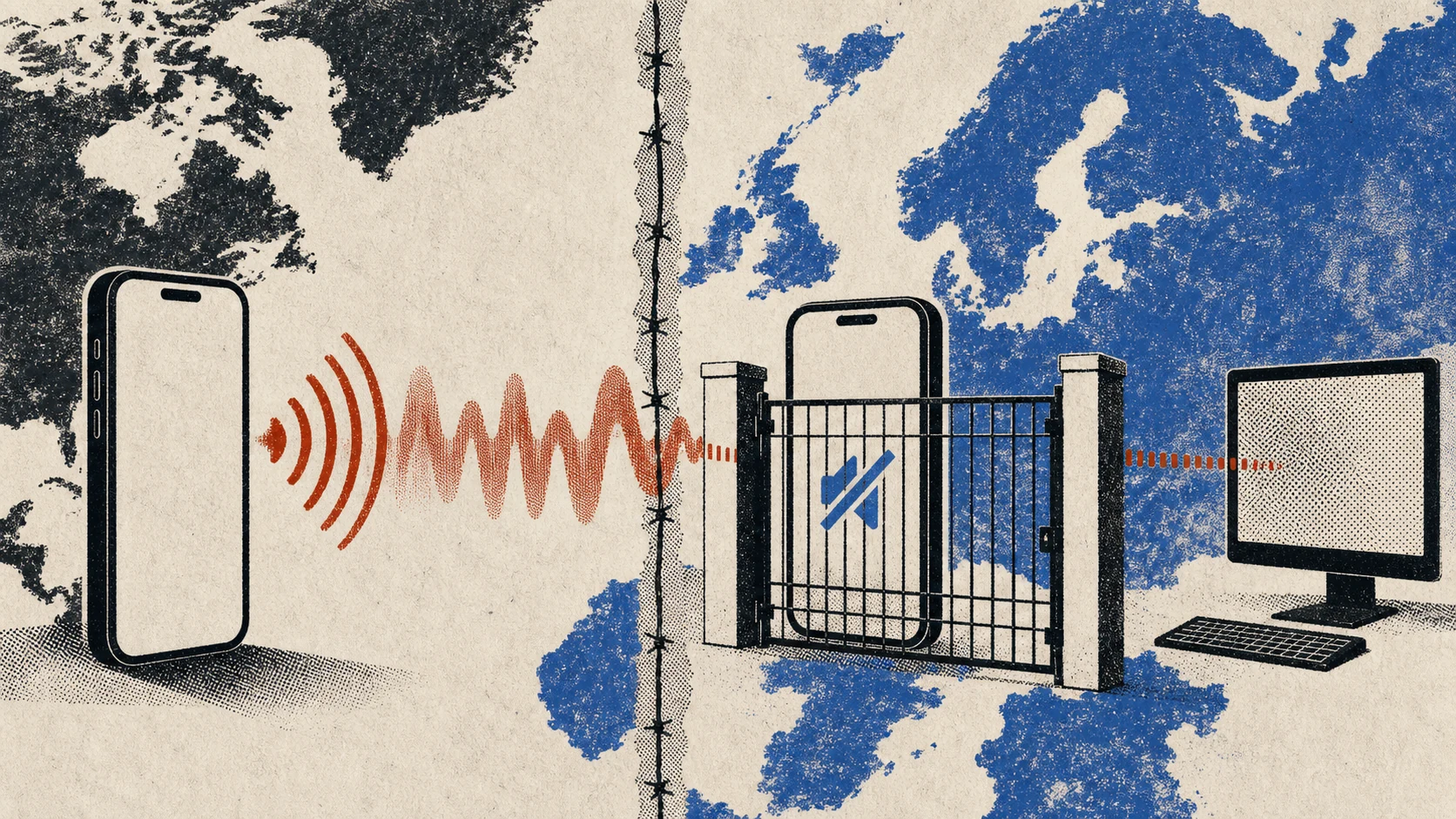
Apple used its June 8 developer conference to introduce Siri AI, a rebuilt assistant that can hold longer conversations, search personal messages and photos, understand what is on the screen and take actions across apps. Developer testing began that day, with a public beta promised later in 2026.1,3
The same day, Apple announced that iPhone and iPad users in the European Union would not receive Siri AI initially with iOS 27 and iPadOS 27. Mac and Vision Pro users in the EU remain in the launch plan. Siri AI on Apple Watch is also unavailable there at launch because it requires a paired iPhone with Siri AI.2
The split turns a software update into a regional product difference. An EU buyer can own the same phone model as a buyer elsewhere, install the same numbered operating system and still receive a meaningfully different assistant. That deserves more attention than the stage demo.1,2,3
What Apple says the new assistant can do
Siri AI is designed to move between general web knowledge and the information stored across a user's devices. Apple's examples included finding a restaurant mentioned in a message, retrieving a hotel confirmation from email, answering a question about the current screen and editing or sharing photos through app actions.1
A dedicated Siri app will keep conversation history available across Apple devices through iCloud. On iPhone, users can start a conversation from the Dynamic Island. On Mac and iPad, the assistant appears inside Spotlight and context menus. Ars Technica's account also noted that Apple demonstrated pauses and scripted exchanges rather than presenting an open public test.1,3
Apple says on-device models will handle some work. When Private Cloud Compute handles a more demanding request, Apple says personal data is not stored or made accessible to Apple. That privacy architecture remains a company claim until the released system can be examined under ordinary use. Some image-generation functions will also have daily limits, with larger allowances attached to iCloud+ plans.1,3
The hardware inside the promise
Not every device that currently supports Apple Intelligence will receive the same version. Ars Technica reported that Apple's most capable on-device model requires an iPhone Air, iPhone 17 Pro or iPhone 17 Pro Max; an iPad with an M4 chip or later and at least 12 GB of unified memory; or a Mac with an M3 chip or later and at least 12 GB. Other eligible devices receive a less capable model.3
That distinction can affect voice expressiveness, dictation and how much work stays on the device. It also makes memory capacity a software feature boundary. A device may be eligible for iOS 27 and Apple Intelligence while missing the version shown in the keynote.1,3
Buyers should therefore ignore a generic 'supports Apple Intelligence' label. The useful question is which Siri AI tier the exact model receives, in which language, and in which country. Apple says the new assistant starts in English, with more languages planned later.1,3
Why the EU version is different
Apple blames its delay on the Digital Markets Act and a dispute over access for competing virtual assistants. The company argues that opening system actions and personal context to other assistants could expose messages, files, purchases and app controls. It says regulators rejected a proposed intermediary called Trusted System Agent.2
Those statements describe Apple's case. They do not establish that EU regulators demanded unlimited or unsafe access, and Apple's announcement did not include a regulator's response. The dispute sits between two real objectives: preventing one platform owner from reserving privileged capabilities for itself, and preventing third-party agents from receiving access that users do not understand.2
For consumers, the immediate fact is narrower. Siri AI will not ship on EU iPhones and iPads with the initial iOS 27 release. Apple supplied no date for later availability. Mac and Vision Pro remain eligible in the region, so the restriction is tied to the affected mobile platform rather than the user's Apple account alone.2
Do not buy a phone for an unreleased assistant
The new Siri is still in developer testing. Public beta software can change, arrive late or lose a demonstrated feature. Apple has also separated model capability by hardware and availability by jurisdiction. A purchase made around a keynote promise carries more uncertainty than a purchase based on functions available in the store today.1,2,3
An EU user who needs the assistant should wait until Apple publishes an actual release date and a device compatibility list for the region. Changing the App Store country is unlikely to be a responsible workaround for an availability restriction and can interfere with subscriptions, payment methods and family sharing.2
Outside the EU, the same caution applies to language and hardware tier. Test whether dictation, search and accessibility features already solve the task. A new conversational interface is less useful if the important action still requires confirmation, a cloud connection or an app that has not adopted the relevant integration.1,3
Privacy depends on defaults people can see
An assistant that can search messages and emails is useful precisely because it has access to sensitive context. Users need a clear view of which sources are connected, whether conversation history syncs through iCloud, which work stays local, which work reaches Private Cloud Compute and when web services are involved. A privacy architecture cannot remain a keynote diagram.1,3
The dedicated history app creates a new place to review and remove past conversations, but it also creates another retained record. Before using personal context for work or family matters, check deletion controls, device sync and account security. Shared iPads and family devices deserve extra care.1
The EU delay may eventually produce a safer interoperability design or a prolonged regional gap. Neither outcome is settled. For now, the responsible comparison is simple: judge the phone available in your country, on your exact hardware, with the software that exists when you buy it.1,2,3
- Check the exact model's Siri AI tier rather than relying on a family-level compatibility label.
- EU buyers should wait for an explicit iPhone and iPad release date.
- Review iCloud conversation history and personal-context controls before connecting sensitive data.
- Treat public beta features as unfinished software.
Sources and method
Feature descriptions and privacy claims are Apple's. Ars Technica independently reported the demonstration, device tiers and cloud limits. Apple's description of the Digital Markets Act dispute is a party's position, not a neutral account of EU law, so we do not present its allegations about regulators as settled fact.
- Apple introduces Siri AI Apple Newsroom · June 8, 2026 · primary
- Due to DMA, Siri AI delayed in EU for iOS 27 and iPadOS 27 Apple Newsroom · June 8, 2026 · primary
- Say hi to Siri AI Ars Technica · June 8, 2026 · independent